Show results for
Explore
In Stock
Artists
Actors
Authors
Format
Theme
Genre
Rated
Studio
Specialty
Decades
Platforms
Size
Color
Deals
- Collectible Magazines
- Hundreds of Hits Only $8.78
- Save With Our Recent Hits Roundup
- Region Free Imports for Collectors
- Golden Age Greats from the '30s to the '50s
- Silver Age Spectaculars from the '60s to the '80s
- Modern Age Masterworks from the '90s to Now
- Movies for the Man-Cave
- Shows for the She-Shed
- Flicks for the Fan-Cave
- Arthouse to Your House
- Favorites on 4K Ultra HD
- All Classics, None in Stores
- Clean Up with our Spring Sale
- Better looking than ever on Blu-ray!
- Tons of TV Treasures on sale!

Blu-ray
privacy policy
List Price: $36.99
Price: $31.78
You Save: $5.21 (14%)

Backordered: Get it by
Tue. Apr 21
Deliver to
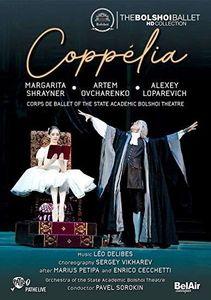
Léo Delibes's Coppélia is not only a collection of fine dances. It is primarily an abrasive and sardonic comedy, which is somewhat unusual in the world of classical ballet. But most importantly, it is a comedy for which excellent music was composed. Pyotr Ilyich Tchaikovsky's assessment of Delibes's ballet scores, allegedly capable of overshadowing the choreography itself, is well known: "What beauty, what elegance, what richness of melody, rhythm and harmony!" It is not fortuitous that music from this ballet should be performed, for it's own merits, during concerts. Funnily enough, the main theme of this light-hearted ballet is taken from E.T.A. Hoffmann's anything but joyful novellas - mainly from The Sandman. In Hoffmann's tale, the young man's infatuation with the doll ends tragically, while in the ballet, the lively and energetic Swanilda (Frantz's fiancée) is able to over wit the old Coppélius, the cunning inventor of the "Girl with the enamel eyes" and free her lover from the doll's poisonous charm. Coppélia was premiered in 1870 at the Paris Opera on choreographer Arthur Saint-Léon's initiative. A virtuoso dancer, Saint-Léon was Marius Petipa's predecessor as Head of the Petersburg Ballet. His interest in folk culture, music and dance, is mainly responsible for the appearance in the music score of such a rich "selection" of dance melodies based on folklore, and especially Slavic and Eastern European themes. A few years later, Marius Petipa and Enrico Cecchetti brought the ballet "back" to the Russia that had proved such a vivid source of inspiration for it's librettist, and adapted the choreography for the Russian stage. However, this new version fell out of interest during the 20th century, until Sergey Vikharev and Pavel Gershenzon's revival in 2009. It is here interpreted by the Bolshoi Ballet's finest dancers: Margarita Shrayner is the witty Swanilda, and Artem Ovcharenko the love-sick Frantz.
- Studio:Bel Air Classiques
- Release Date:4/19/2019
- Item #:2152169X
- UPC #:3760115304635
- Product Type:Blu-ray
- Rating:NR
- Region:A
- Street Date:4/19/2019
